We make other people's sauces too.
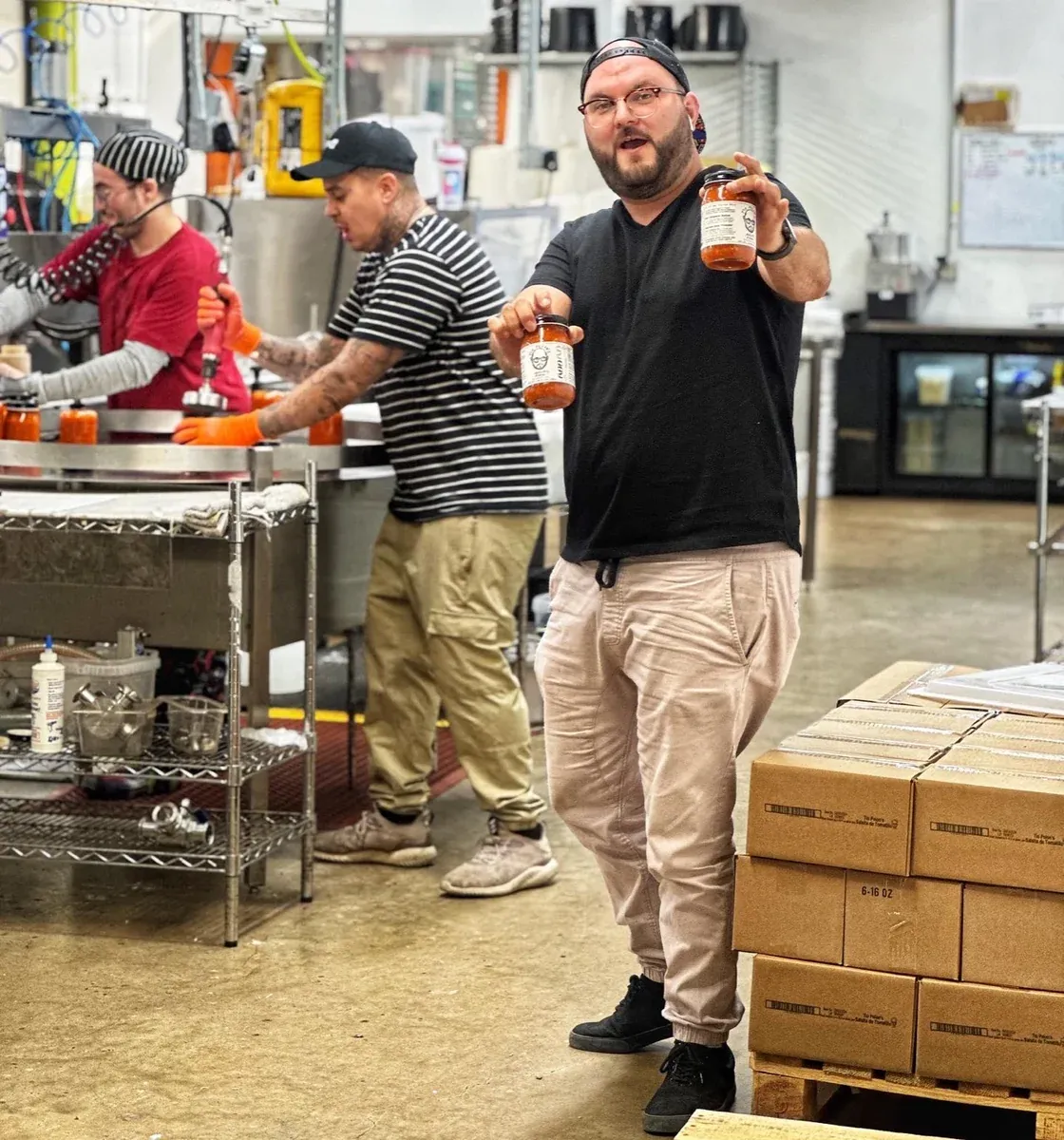
Five other brands run on this line alongside our own. Recipe development through fill, label, case-out and palletising — out of one FDA-registered facility in San Antonio, with the founder on the floor.
Formats we already fill every week.
These are live configurations, not a capability list. Each one has a case spec, a pallet pattern and a station card on the floor.
Salsas, cooking sauces, chili oils, vinegar glazes and hot sauces. Shelf-stable, hot-filled glass and squeeze formats. Another size is usually possible — ask.
Six steps, and we do the paperwork.
Your recipe, or ours
Bring a formula, or bring an idea and we develop it. In-house R&D takes a new product from idea to shelf-ready in four to eight weeks depending on complexity.
Bench samples
Small batches until it tastes right at production scale — which is rarely the same as it tasted in your kitchen. You approve before anything scales.
Process authority
pH, water activity and a scheduled process, documented by a process authority. This is the step most first-timers have never heard of, and it is the one that makes the product legal to sell shelf-stable.
Pilot run
A short real run on the real line. Fill weights, headspace, seal integrity and label placement all get proven before you commit to volume.
Production
Hot fill, cap, label and case. Every batch carries a lot code, and the batch record ties finished cases back to the ingredient lots that went into them.
Cased and palletised
Cases built to a documented pallet pattern with tier sheets and a station card, wrapped and tagged. Retailer-ready, not "we put it on a pallet".
We were the emerging brand once.
Tío Pelón's built itself on this line before it ran anybody else's product. Every part of launching a sauce that is genuinely hard — the process authority, the case spec, the first retailer asking for a pallet configuration you have never heard of — we hit in that order, ourselves.
That is the whole pitch. You are not handing your recipe to a plant that only makes other people's things. You are handing it to a brand that had to solve the same problems to get on a shelf.
- › Short runs are welcome. Most co-packers start at a pallet. We do not.
- › The founder is on the floor. You are not talking to an account manager about a line you will never see.
- › Full traceability. Lot-coded both directions — from a finished case back to ingredient lots, and from a recalled ingredient forward to every case it touched.
- › Your recipe stays yours. We co-pack for competitors of each other and have never had to be reminded why that matters.
Worth being straight about.
A co-packing relationship that starts with a stretch ends badly for both sides. Here is where we are genuinely good, and where we are not.
A good fit
- A restaurant bottling a house sauce for the first time
- An emerging brand doing hundreds or low thousands of units a run
- Anyone who needs the recipe developed, not just filled
- Selling direct, at markets, or into independent and regional grocery
- Shelf-stable salsa, hot sauce, chili oil, cooking sauce or glaze
Not yet a fit
- You need SQF or BRC certification. We are FDA-registered but not third-party audited, and most national chain warehouses require it. This is the honest ceiling on what we can take you into today.
- You need tens of thousands of units a month
- Refrigerated, frozen or aseptic — we run shelf-stable only
- You need cans, pouches or plastic tubs
Tell us what you're making.
Ten questions, about four minutes. Oscar reads every one himself and comes back within two business days — including an honest no if the volume or the format is wrong for us.